


“Should we fine-tune a model?” is the most expensive question in applied AI — because the honest answer is usually no, not yet. There are three ways to make an LLM better at your task: prompting, RAG, and fine-tuning. They solve different problems, cost wildly different amounts, and teams routinely pick the wrong one. Here’s the decision framework we’d actually use in 2026.
📋 In This Article
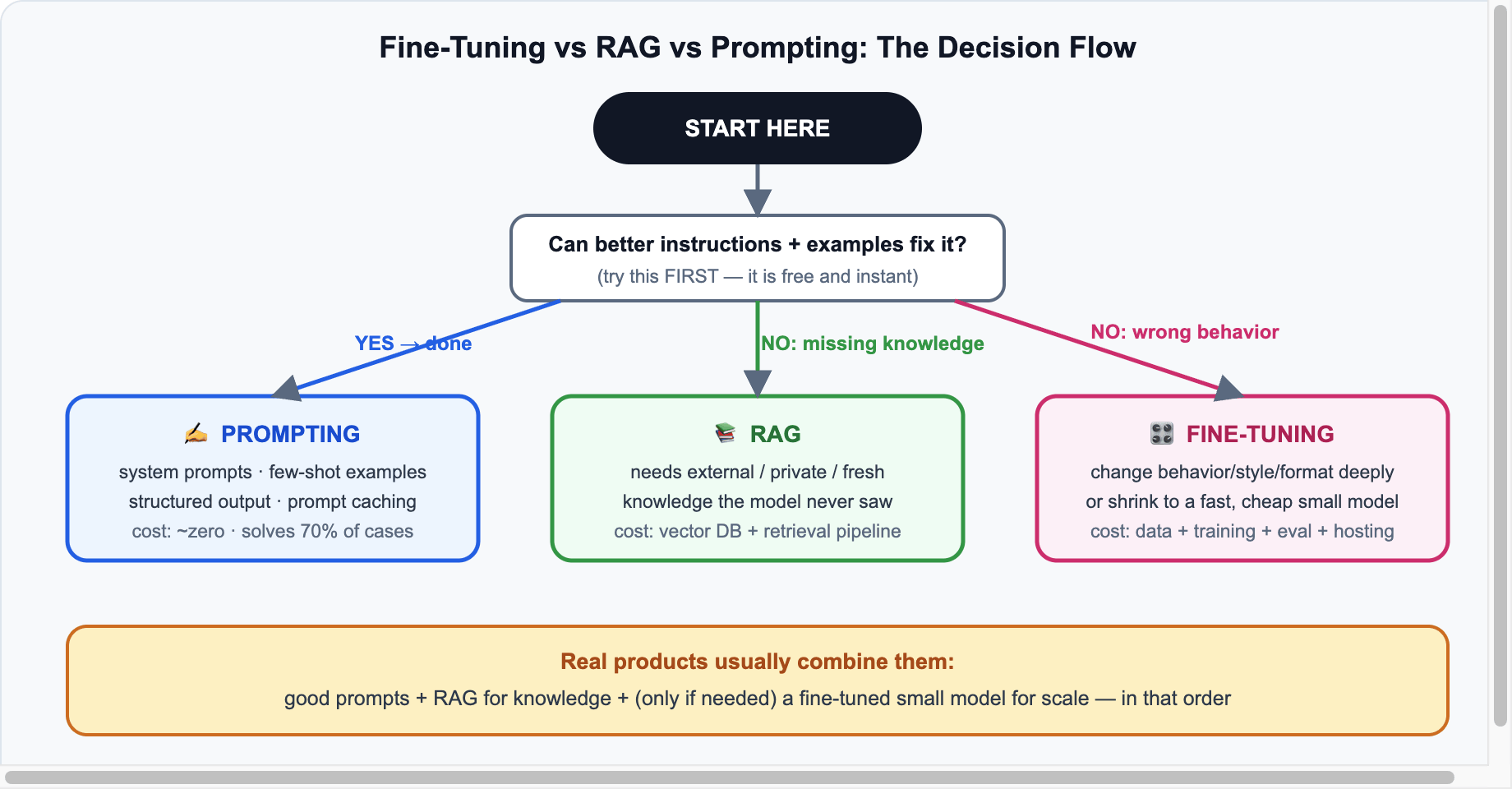
The Decision Flow
Level 1: Prompting — Free, Instant, Underrated
Better instructions, few-shot examples, structured output schemas, and prompt caching solve roughly 70% of “the model isn’t good enough” complaints. Modern frontier models follow instructions so well that most 2023-era fine-tuning use cases (tone, format, persona) are now just a good system prompt.
Reach for it when: output format is wrong, tone is off, the model ignores rules, or accuracy improves with 2–3 examples.
Limits: it can’t teach the model facts it never saw, and giant prompts cost tokens on every call (though caching cuts that dramatically).
Level 2: RAG — When the Model Lacks Knowledge
Retrieval-Augmented Generation fetches relevant chunks from your data (docs, tickets, DB rows) and injects them into the prompt at query time. It’s the right answer whenever the problem is missing or fresh knowledge: internal wikis, product catalogs, anything updated daily.
Why it beats fine-tuning for knowledge: update the index, not the model; sources are citable; no training run, no forgetting, and it works with any model — including local ones via Ollama. The modern pattern is RAG-as-a-tool: the agent decides when to retrieve (we show this in the LangChain tutorial).
Limits: retrieval quality is your ceiling — bad chunking or embeddings mean bad answers; and it adds latency plus vector-DB infrastructure.
Level 3: Fine-Tuning — When Behavior Must Change
Fine-tuning (in practice: LoRA adapters on an open-weight model, or a provider’s tuning API) changes the model’s behavior — not its knowledge base. Two situations genuinely justify it in 2026:
- Deep behavior/format change: a strict domain style, a proprietary DSL, tool-calling patterns the base model keeps fumbling — and prompting demonstrably failed.
- Scale economics: distilling a task onto a small open model (3–8B) so it runs faster and ~10x cheaper than calling a frontier API a million times a day.
Real costs people forget: curating 500–10,000 quality examples (the actual bottleneck), eval design, retraining on every base-model upgrade, and hosting. Research systems like Stanford’s TRACE (our breakdown) point the way: diagnose the missing capability first, then train narrowly on it.
Side-by-Side
| Prompting | RAG | Fine-tuning | |
|---|---|---|---|
| Fixes | instructions, format, tone | missing/fresh knowledge | behavior, style, scale cost |
| Setup cost | ~zero | days (pipeline + vector DB) | weeks (data + training + evals) |
| Update speed | instant | re-index (minutes) | retrain (days) |
| Citable sources | — | ✅ yes | ❌ no |
| Works with any model | ✅ | ✅ | ❌ model-specific |
| Biggest risk | prompt bloat | bad retrieval | wasted budget, forgetting |
How Real Products Combine All Three
A typical 2026 production support bot: a tight system prompt (persona, rules, output schema) + RAG over the help center (fresh, citable answers) + optionally a fine-tuned small model for triage/routing where volume makes frontier APIs uneconomical. In that order — each layer added only after the previous one measurably fell short.
✅ The One-Line Rule
Wrong instructions → prompt. Missing knowledge → RAG. Wrong behavior at scale → fine-tune. And always in that order.
Further reading: OpenAI: optimizing LLM accuracy · Anthropic prompt engineering guide · original RAG paper · LoRA paper.






Leave a reply
Your email address will not be published. Required fields are marked *