

AI agents have an embarrassing habit: they fail the same way, over and over. A Stanford research team traced this to something specific — missing, reusable capabilities — and built a system that finds those gaps and trains for them directly. It’s called TRACE (Turning Recurrent Agent failures into Capability-targeted training Environments), and it’s open-source under an MIT license.
📋 In This Article
The Problem TRACE Solves
When an agent fails a task, the two standard fixes both waste compute:
- Direct RL or SFT gives sparse rewards that never tell you which skill was missing — the model gets a zero and no explanation.
- Broad synthetic data is untargeted, so training budget flows to skills the model already has.
💡 The Core Insight
Agent failures are not random. A small set of capability deficits accounts for most failed trajectories — so each recurring deficit can become its own dense, verifiable training signal.
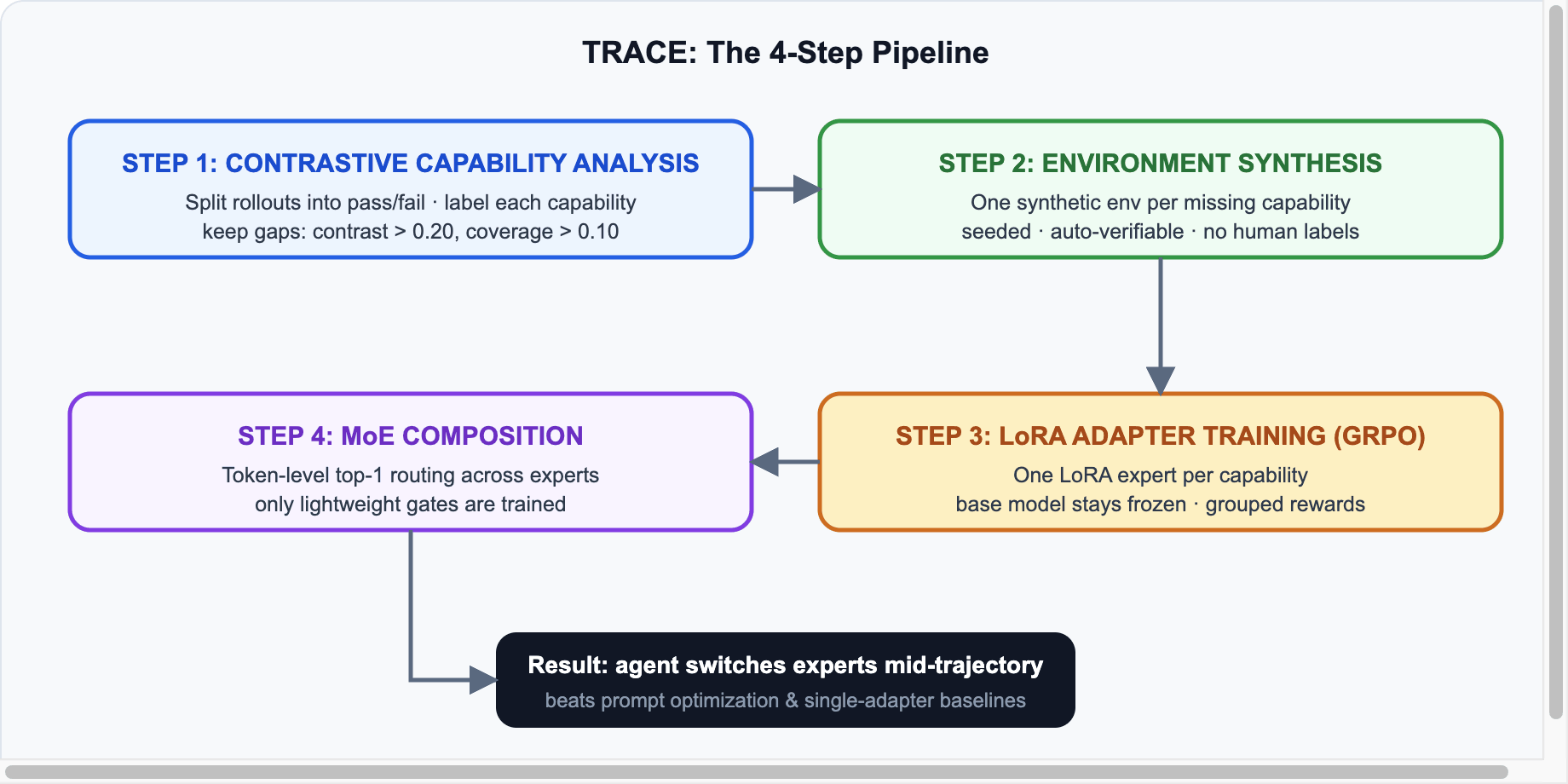
The 4-Step Pipeline
Each Step Explained
Step 1: Contrastive capability analysis
The base agent generates rollouts in the target environment. An analysis agent (an LLM following a markdown prompt) splits them into successful and failed sets, then labels every trajectory-capability pair as NA, PRESENT, or LACKING. A capability is kept only if it’s genuinely contrastive — its gap between failures and successes must clear δ = 0.20, and it must appear in at least ρ = 0.10 of trajectories. That filters out noise and keeps skills whose absence concentrates in failures.
Step 2: Targeted environment synthesis
A generation agent builds one synthetic environment per retained capability, isolating that single skill while preserving the original environment’s tool schemas and formats. Task instances are procedurally generated from random seeds, and because generation and verification are algorithmic, rewards need no human labels and no LLM judge.
Step 3: Capability adapter training
Each capability gets its own LoRA adapter, trained on its synthetic environment with GRPO (Group Relative Policy Optimization) — the same algorithm family DeepSeek popularized. Rollouts are grouped by shared seed so scenarios are identical within a group, and rewards are normalized within each group. The base model stays completely frozen.
Step 4: MoE composition with token-level routing
Finally, the adapters are composed into a Mixture-of-Experts model. Backbone and adapters stay frozen; only lightweight token-level gates are trained. At inference, each token routes top-1 to a single capability adapter — meaning the agent can switch experts mid-trajectory as the task shifts from, say, record retrieval to precondition verification.
Results and Why They Matter
On τ²-Bench with Qwen3-30B-A3B, targeted training plus MoE composition beat both prompt optimization and single-adapter baselines. The bigger story is the method: failure analysis → targeted synthetic environments → composable experts is a loop that any team can run continuously as their agent hits new walls.
What Builders Should Take Away
- Stop retraining everything. Diagnose which specific capability is failing before spending on RL.
- Synthetic doesn’t mean sloppy. Seeded, procedurally-verified environments give dense rewards without labeling costs.
- LoRA + routing is cheap modularity. Frozen base + per-skill adapters means you can add capabilities without catastrophic forgetting.
Sources & further reading: MarkTechPost coverage · LoRA paper · TRACE is released open-source under MIT license.



Leave a reply
Your email address will not be published. Required fields are marked *