


Six months into 2026 and the LLM market has never moved faster: Anthropic’s Claude Fable 5 launched (and survived a brief export-control shutdown), OpenAI shipped GPT-5.6, Google’s Gemini 3.1 Pro took the science crown, and open-weight models closed the coding gap. Here’s a plain-English map of which model to actually use, and for what.
📋 In This Article
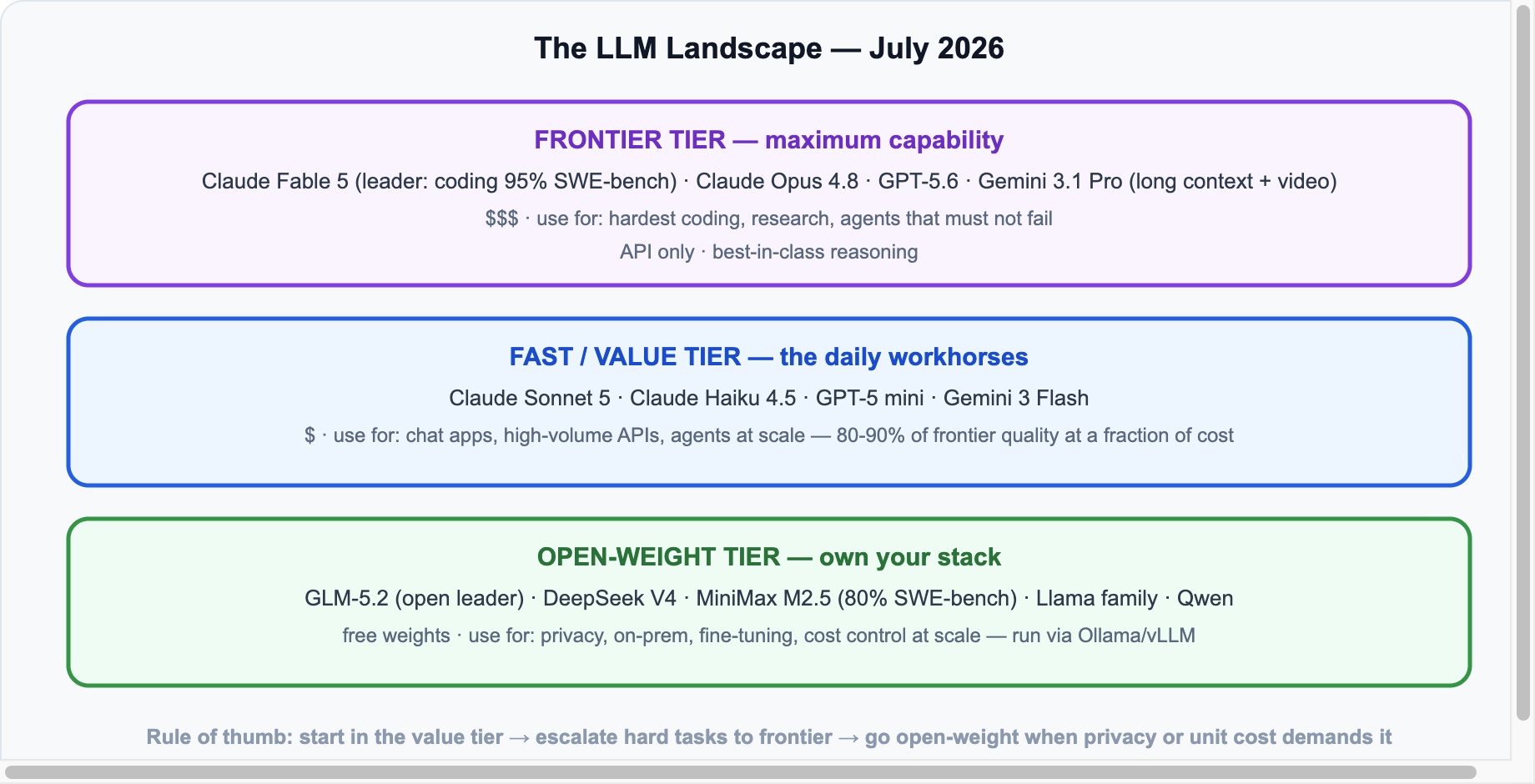
The Three Tiers
Frontier Tier: The Leaders
- Claude Fable 5 (Anthropic) — current leader on public intelligence rankings, with a clear margin on frontier coding (95.0% on SWE-bench Verified) and Humanity’s Last Exam (53.3%). It made headlines twice in June: first as the top model, then when a US export-control order briefly forced it offline over vulnerability-finding capabilities — it returned globally on July 1 with new safeguards, priced at $10/$50 per million tokens.
- Claude Opus 4.8 — Anthropic’s workhorse flagship, right behind Fable 5 and cheaper; the default for serious coding without Fable-tier budgets.
- GPT-5.6 (OpenAI) — the everything-model: multimodal + reasoning unified (the GPT-4o, o3 and Codex lines merged). GPT-5.4 still leads specifically on computer use.
- Gemini 3.1 Pro (Google) — the scientist: leads GPQA Diamond (94.3%) and abstract reasoning (ARC-AGI-2, 77.1%), and remains unmatched on huge documents and video understanding.
Value Tier: The Daily Workhorses
Most production traffic shouldn’t hit frontier models at all. Claude Sonnet 5, Claude Haiku 4.5, GPT-5 mini and Gemini 3 Flash deliver 80–90% of frontier quality at a fraction of the price and latency. The standard 2026 pattern is router architecture: default to a value model, escalate to frontier only when the task demands it.
Open-Weight Tier: Own Your Stack
- GLM-5.2 — the open-weights leader (91.2% GPQA), remarkably close to closed frontier on reasoning.
- MiniMax M2.5 — 80.2% on SWE-bench: open models can now genuinely code.
- DeepSeek V4 — the cost king for API-style serving at scale.
- Llama family (Meta) — outpaced on raw intelligence but still everywhere, with the deepest tooling ecosystem, and dead simple to run locally.
💡 The 2026 Shift
The gap between closed frontier and open weights is now months, not years. If privacy, unit cost, or fine-tuning control matters, open-weight + Ollama/vLLM is a serious production choice — not a hobby.
How to Pick: Cheat Sheet
| Your need | Use |
|---|---|
| Hardest coding & agents | Claude Fable 5 / Opus 4.8 |
| General assistant, multimodal | GPT-5.6 |
| Science, math, huge docs, video | Gemini 3.1 Pro |
| High-volume app traffic | Sonnet 5 / GPT-5 mini / Gemini 3 Flash |
| Privacy / on-prem / fine-tuning | GLM-5.2, DeepSeek V4, MiniMax M2.5 |
| Local on a laptop | Llama / Qwen via Ollama |
Bottom line: there is no single “best” LLM in 2026 — there’s a best model per job, and the winning teams route between them.
Sources & further reading: LLM-Stats leaderboard · BenchLM July 2026 · Zapier’s Best LLMs 2026 · Codingscape roundup. Benchmarks as reported July 2026; scores shift monthly — check leaderboards before committing.



Leave a reply
Your email address will not be published. Required fields are marked *