



On July 10, 2026, Apple filed a lawsuit against OpenAI in the U.S. District Court for the Northern District of California, accusing the ChatGPT maker of trade secret theft and breach of contract. This isn’t a routine legal spat between tech giants — it lands right in the middle of OpenAI’s push to build its first hardware device, a product that could compete directly with the iPhone.
📋 In This Article
Key Points at a Glance
- Who: Apple vs OpenAI, with two former Apple employees named — Chief Hardware Officer Tang Tan and engineer Chang Liu.
- What: Allegations of stolen confidential documents, misused project code names, and recruiting tactics designed to extract Apple’s secrets.
- Why it matters: OpenAI is rumored to be building an AI-first phone where agents replace apps — potentially the biggest threat to Apple’s core business in years.
- What Apple wants: A court order blocking OpenAI from using its trade secrets, return of confidential materials, and evidence preservation.
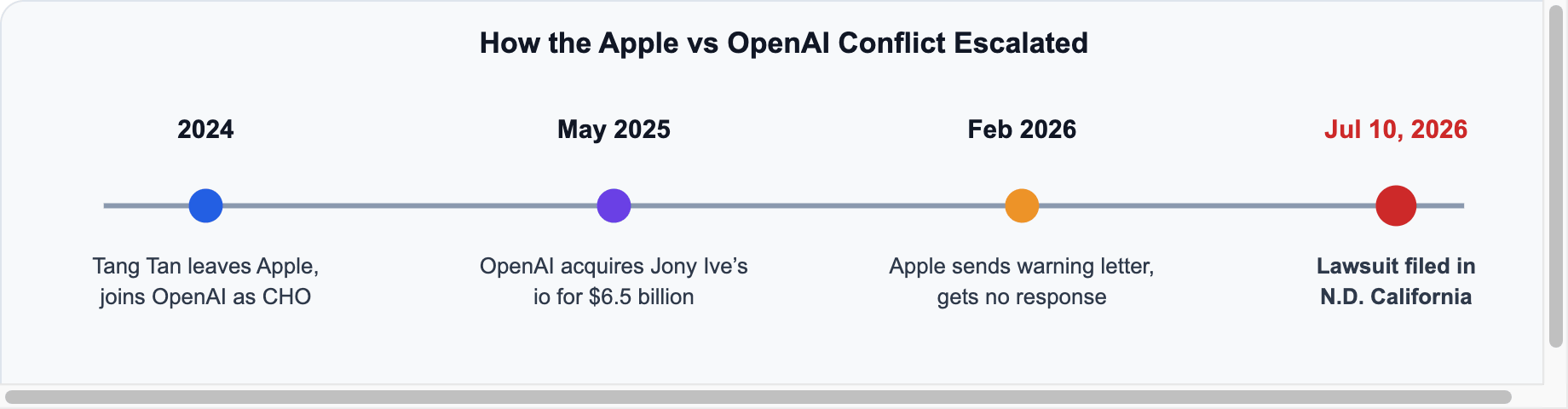
How the Conflict Escalated
The Allegations Against Tang Tan
Tang Tan spent 24 years at Apple, most recently as VP of product design for the iPhone and Apple Watch, before becoming OpenAI’s Chief Hardware Officer. According to the complaint, Tan used Apple’s confidential project code names during recruiting conversations, asked job candidates to bring Apple hardware components to interviews, and even coached departing Apple employees on how to slip past the company’s security procedures.
Apple alleges this behavior wasn’t rogue conduct by one executive — the filing claims it was directed by OpenAI’s senior leadership as part of a deliberate strategy to extract confidential information about component selection, vendor processes, and unannounced products.
The Laptop That Never Came Back
The second named employee, Chang Liu, worked eight years at Apple as a senior systems electrical engineer. The lawsuit claims he never returned his Apple-issued laptop after leaving for OpenAI in 2026, and used it to download confidential technical documents — engineering presentations, technical specifications, and proprietary project data covering unannounced products.
Apple also alleges Liu shared internal information with other Apple employees who were applying to OpenAI, advising at least one on what to study before the interview. One striking detail from the filing: OpenAI allegedly used a proprietary Apple metal finishing technique after misleading a manufacturing partner into believing it had Apple’s permission.
The Real Story: The AI Hardware War
The timing tells you everything. OpenAI acquired Jony Ive’s device startup io in 2025 for $6.5 billion, putting Apple’s most famous former designer in charge of its hardware ambitions. Industry analyst Ming-Chi Kuo has suggested OpenAI’s first device could be a smartphone built around AI agents instead of apps.
If that device ships, it won’t just be another gadget — it would challenge the app-centric model that powers Apple’s services revenue. Apple says it sent OpenAI a warning letter in February 2026 and got no response. Filing suit gives Apple something it couldn’t get otherwise: legal discovery, meaning access to OpenAI’s internal communications.
What Happens Next
Expect OpenAI to respond publicly within days and file a motion to dismiss within weeks. Trade secret cases of this scale often take 18–24 months to resolve, and many end in settlement. But even before any verdict, the discovery process could expose details about OpenAI’s hardware roadmap that it would much rather keep private.
⚠️ Why This Matters for the Industry
This case is a warning shot about the AI talent war: hiring aggressively from a competitor is legal — but what those hires bring with them can turn into a billion-dollar liability. Every AI lab recruiting from Big Tech will be reviewing its onboarding policies this week.
Sources & further reading: TechCrunch report · Full court filing (DocumentCloud) · OpenAI phone rumors. All claims described above are allegations from Apple’s complaint; OpenAI has not yet responded in court.





Leave a reply
Your email address will not be published. Required fields are marked *